
The COP31 Presidency of Türkiye has released a new pledge calling for cleaner energy use, better environmental reporting, and more responsible development of artificial intelligence (AI). The initiative aims to address the growing climate impact of AI while using the technology to support climate solutions.
Released on October 27, 2026, the Antalya AI Pledge invites governments and organizations to make voluntary commitments on AI and climate action. It focuses on the environmental costs of running AI systems, including the electricity and water needed by data centres. It also calls for more financial and technical support to help developing countries use AI for climate action.
The pledge comes as demand for AI services grows worldwide. Data centres need large amounts of electricity to train AI models, answer user requests, and run cloud services. The challenge for governments and technology companies is to meet this demand without slowing efforts to cut greenhouse gas emissions.
What the Antalya AI Pledge Aims to Change
The pledge sets out a voluntary approach to making AI more climate-friendly. It covers how AI is designed, purchased, powered, used, measured, and managed.
One key focus is greater transparency about AI’s environmental impact. Governments and organizations are being encouraged to improve reporting on the energy and other resources used by AI systems. Better data can help policymakers, investors, and companies understand the environmental costs of AI and identify where improvements are needed.
The pledge also calls for data centres to use lower-emission energy. This could mean increasing the use of clean electricity, such as wind and solar power, and improving how facilities use energy.
Another goal is to help developing countries gain access to funding, technology, and expertise for AI projects that support climate action. These projects could use AI to improve energy systems, support cleaner industries, or help communities prepare for climate risks.
However, the pledge is voluntary, not a binding climate regulation. It does not automatically require every country or technology company to meet specific emissions limits. Its impact will depend on how many organizations support it and whether they follow through with measurable action.

Data Center Power Demand Is Set to Rise
The pledge addresses a growing challenge for the global energy system. Data centres already use significant amounts of electricity, and demand is expected to rise as AI services expand.
The International Energy Agency (IEA) estimates that data centers will use about 415 terawatt-hours (TWh) of electricity in 2024. This is roughly 1.5% of global electricity use. The agency expects this figure to more than double to about 945 TWh by 2030, with AI as the main driver of the increase. One terawatt-hour is one billion kilowatt-hours of electricity.
Goldman Sachs analysis also shows the same data, increasing power use by over 160% by the decade’s end.
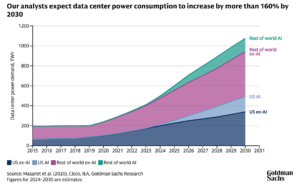
Meeting this demand could put pressure on electricity grids, especially in areas where data centres are growing quickly. If new power supplies rely heavily on coal or natural gas, the expansion of AI could also increase emissions.
The IEA expects renewable energy to meet a large share of the additional electricity demand from data centers. However, natural gas and other power sources will also play a role. The actual impact on emissions will depend on the energy mix in each region and how quickly new clean power becomes available.
This makes the pledge’s focus on cleaner electricity important. But simply buying renewable energy or announcing clean power deals does not always mean a data center runs entirely on clean electricity at every hour. Tracking actual power use and emissions will help show whether companies are making progress.
- SEE MORE: AI’s Environmental Cost: Data Centers Now Rival Entire Nations in Energy, Water, and Land Use
Emissions Reporting Still Has Gaps
Better reporting is another major issue for the technology sector. Companies may disclose some of their emissions but leave gaps in their reporting on electricity use, suppliers, equipment, and other parts of their business.
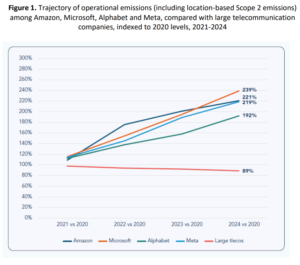
A report from September 2026 by the International Telecommunication Union (ITU) and the World Benchmarking Alliance (WBA) looked at 200 digital companies. They used publicly available information for the 2024 reporting year. It found that 89% reported direct emissions, while 81% reported emissions from purchased electricity and other energy. Only 47% reported emissions across all relevant value chain activities.
These categories are often called Scope 1, Scope 2, and Scope 3 emissions:
- Scope 1: Direct emissions from sources a company owns or controls.
- Scope 2: Emissions linked to the electricity, heating, and cooling it buys.
- Scope 3: Other indirect emissions across its value chain, including those linked to suppliers and equipment.
For AI companies, these wider emissions matter because data centres need servers, chips, buildings, cooling systems, and other equipment. Producing and transporting these materials can add to a company’s total carbon footprint.
The ITU and WBA report found that 200 companies had 301 million metric tons of operational emissions from Scope 1 and Scope 2 in 2024. This was a 1.2% increase from 2023. This figure covers the digital companies assessed, not AI alone. It shows why better reporting and emissions cuts remain important as digital services expand.
AI Could Also Help Cut Emissions
The pledge does not focus only on AI’s environmental costs. It also seeks to encourage the use of AI to support climate action. AI tools can help energy companies forecast electricity demand, manage power grids, and improve the use of renewable energy. They can also help industries identify ways to reduce energy use and support early warning systems for extreme weather.
The chart below shows projected global greenhouse gas emissions (in GtCO₂e) and potential reductions driven by AI across key sectors by 2035.
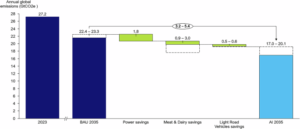
Türkiye’s COP31 Presidency has also announced an AI for Clean Technologies Initiative. It aims to develop pilot projects that use AI in areas such as smart energy systems and cleaner industry, while connecting these projects with business partners and investors.
Still, potential benefits should not be confused with proven emissions reductions. An AI tool can help a company save energy. However, the overall climate benefit depends on a few factors. It matters how widely the tool is used, how much energy it needs, and if it actually reduces emissions.
The challenge is to measure emissions avoided by AI applications carefully, and not just assume these reductions are greater than the emissions generated by the technology itself.
Developing Countries Need Funding and Support
The pledge also highlights the need for financial and technical support for developing countries. Many countries face barriers to adopting AI for climate action, including limited computing infrastructure, funding, technical skills, and access to reliable electricity.
Support could help these countries use AI to improve energy planning, monitor environmental changes, or strengthen climate adaptation. It could also help local organizations develop projects that use technology to address specific climate risks.
However, the pledge’s call for support will need to translate into practical funding, technology access, and skills development. Without these resources, countries with fewer technical and financial resources may struggle to benefit from AI while managing its environmental costs.
Call for Stronger Accountability: From Voluntary Pledge to Measurable Progress
The pledge has received support as a starting point for international cooperation, but questions remain about how progress will be measured and enforced.
The World Resources Institute (WRI) announced on October 27 that the pledge focuses on two key points. First, it highlights the chances AI brings for climate action. Second, it addresses the strain data centers put on electricity, water, and local communities. However, WRI also warned that the pledge lacks strong accountability measures.
The organization called for clearer requirements on energy and water reporting, cleaner power for data centres, and greater involvement of local communities in decisions about new facilities. These issues matter because data centres can affect local power supplies, water resources, and air quality.
The first progress review at COP32 could provide an opportunity to assess whether countries and organizations have turned their voluntary commitments into action. However, the results will depend on the quality of the data reported and whether participants set clear goals and follow through.
The Antalya AI Pledge brings the environmental impact of AI into the wider climate discussion. It recognizes that AI can help address climate change, but that the infrastructure behind it also uses energy and resources.
Its success will depend on more than the number of countries and organizations that sign on. Progress will need to show up in better emissions reporting, cleaner electricity supplies, more efficient data centres, and measurable climate benefits from AI applications.
The post COP31 Presidency Calls for AI Pledge Pushing Cleaner Data Centers and Emissions Reporting appeared first on Carbon Credits.


