
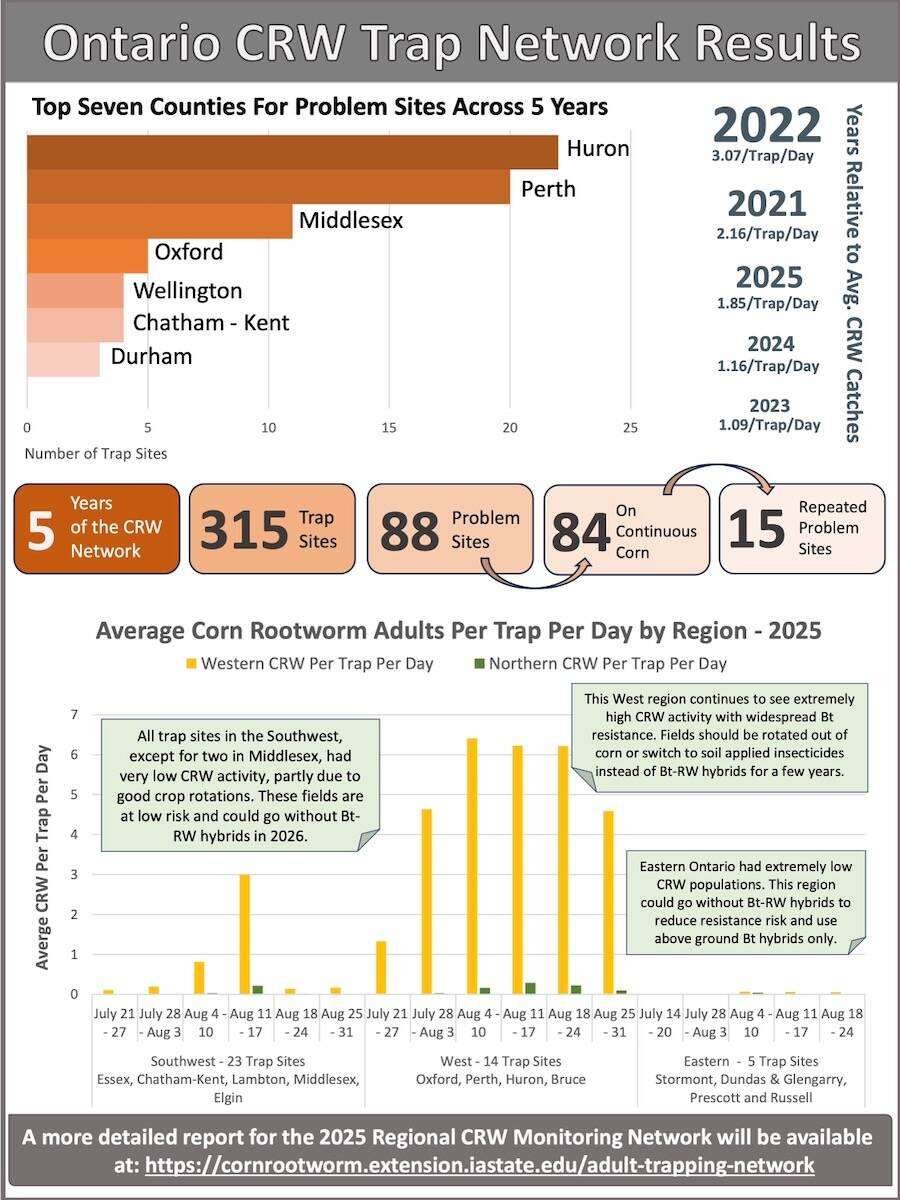
Five years of data from Ontario’s Corn Rootworm Trap Network show the pest continues to be a problem for parts of the province with significant corn-on-corn acres, with resistance to both Bt and RNAi traits an ongoing concern.
The take-home message — in areas of high rootworm pressure, do all you can to increase crop rotation.
WHY IT MATTERS: Corn rootworm is a serious pest, though one largely controlled with crop rotation, and Bt and RNAi technology. Populations resistant to both of the latter, however, remain a growing problem.
Results from 2025
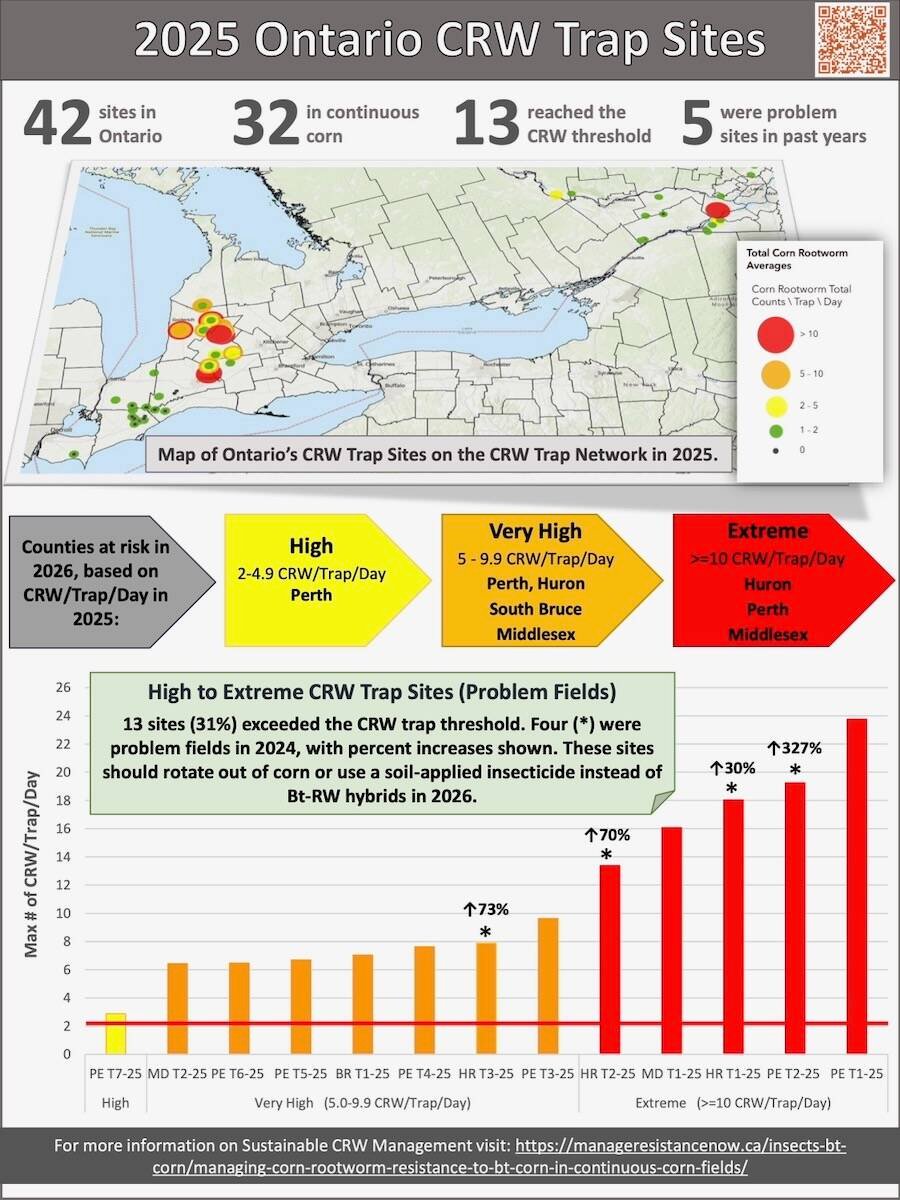
Tracey Baute, field crop entomologist with the Ontario Ministry of Agriculture, Food and Agribusiness, said corn rootworm pressure in 2025 was significant on the whole, though less so than in 2022 and 2021. Thirteen trap sites reached or exceeded threshold, 12 of which landed in the Very High to Extreme categories. As with other years, it’s recommended fields in these categories be rotated out of corn and treated with a soil applied insecticide in 2026.
Writing in Field Crop News, Baute said Huron, Perth and Middlesex counties in particular, continued to see extremely high levels of rootworm adults. This matches with the reports to the Canadian Food Inspection Agency of unexpected damage on Bt hybrids.
“Western corn rootworm was the dominant species in 2025 with 81 per cent of the sites having only western corn rootworm found on traps. Seventeen per cent of sites this year had no corn rootworm trapped at all. As usual, these sites are in rotated fields and are in areas not dominated by continuous corn production,” said Baute.
“High-risk counties for rootworm in 2026 based on trap results include Perth, Huron, south Bruce, and Middlesex. These counties should consider changing up their rootworm management practices to reduce the spread of Bt resistant populations.… Switching the hybrids with the RNAi trait in these problem counties increases the risk of RNAi resistance developing. Studies have shown that when the RNAi trait is the only functioning mode of action against corn rootworm, resistance can develop within three years to the RNAi trait.”
Take-home message
Speaking later, Baute said results from 2025 “just reiterated the issues” identified in years past.
“It was such a heavy year, it proves what we’ve been saying for the last five years. Corn rootworm won’t go away without more crop rotation. And use those Bt and RNAi hybrids when absolutely needed, but not making it your go-to.”
Why the rootworm resistance issues persist is, for Baute, a result of two thing: a partial failure in messaging from the ministry and its partners, and the constraints inherent in the systems within which many livestock farmers operate. Manure management, animal nutritional needs, land base considerations and other agronomic pressures are all factors in determining crop rotation.
“We’re so used to delivering the message to certain groups, and not necessarily landing in front of the people having the biggest issue with it,” Baute said. “It also takes a year or two of what they’re experiencing to show they do have a problem. Any of the insect pests are sometimes challenging to get your head around. We definitely need to work on the side of improving communication and helping them move towards those sustainable practices.”
“It’s a system issues. We are all part of the problem but also the solution.”
Baute added one (somewhat counterintuitive) positive is that no matter how bad the Bt and RNAi resistance in corn rootworm becomes, it remains a pest that can be controlled with rotation.
“It’s now to the point where we could wait to see what happens, or try to fix the solution now.… We want to see those technologies there for when we really, really need it. I think 2025 was a lesson, even for crop representatives, realizing this can’t proceed as usual.”
Traps available
Having a rootworm trap on the farm itself helps prevent rootworm challenges from getting worse. Though imperfect measurement tools, traps support growers in their scouting activities, and can help identify if the following year will bring high rootworm pressure.
“I see trapping as having a key role in this,” said Baute.
Trap supplies will be made available to anyone who is interested in trapping at sites in 2026. Contact Tracey Baute directly to be added to the corn rootworm trap participant list.
The post Corn rootworm traps tell tale of the insect’s resistance appeared first on Farmtario.


