
By Emily Negrin, Inari Vice President, Corporate Communications
Farmers have always relied on seed improvements to stay productive in ever-changing environments. From the advent of plant breeding to modern practices, each leap forward has helped manage risk, protect yields, and make better use of resources. Today, one of the most important advances in breeding techniques is the use of gene editing, a biological tool capable of unlocking improvements with unmatched speed and precision.
One of the most advanced technologies to perform gene editing – and perhaps the best known – is the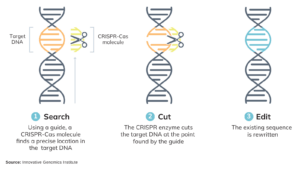 CRISPR-Cas (Clustered Regularly Interspaced Short Palindromic Repeats) system, which allows scientists to make extremely precise changes to plant and animal DNA. Acting essentially like a pair of scissors guided by a molecular GPS, a CRISPR-Cas molecule finds a specific location in the plant’s DNA and makes a precise cut. This engages the plant’s own natural repair process, which can be used to produce a desired range of changes.
Another way to think of CRISPR-Cas is as a word processor for DNA. Scientists can now delete or replace individual “letters” in the genetic code. Notably, this process works within the plant’s own natural DNA, acting as a breeding accelerator that operates in tandem with traditional breeding and other biotechnologies.
Enabled by the convergence of major technological advances in artificial intelligence (AI) and genomic research, gene editing accelerates outcomes that previously would have taken as long as a decade to achieve. The kinds of changes made through CRISPR-Cas are like those that could occur naturally or through conventional breeding—just faster and more exact. Some genes may be turned off, others dialed up, down, or improved in their functionality.
Still, unlocking the full potential of seed requires more than science. As a globally traded commodity, grain is subject to unique policies established by each importing nation. The seed industry advocates for regulations worldwide based on sound science that enables innovation by eliminating unnecessary oversight. Great progress is being made, with ever more countries recognizing gene editing as a new breeding technique exempt from onerous GMO regulations, instead, opting for a regulatory consultation process.
As farmers look ahead, the pressure to produce more with fewer inputs will only increase. While there are no silver bullet solutions, gene editing represents a major step forward, building on thousands of years of breeding knowledge with modern tools and capabilities designed to help overcome today’s challenges. This next generation of seed innovations will enable stronger performance, better efficiency, and greater resilience in the face of an increasingly demanding farming environment.
A BRIEF HISTORY OF BREEDING
Gene editing is a crucial step forward in the 12,000-year history of breeding. To recognize the impact of this technology, it is important to understand what came before.
Breeding 1.0: Humans chose and crossed plants with specific features they liked. This incidental approach – effective, but also incredibly slow and painstaking – covered the first 10,000 years of breeding.
Breeding 2.0: After Gregor Mendel’s discovery of the law of genetic inheritance in the late 19th century, humans began to improve selection efforts through statistics and experiments. This work eventually led to breeder Norman Borlaug receiving the Nobel Peace Prize for increasing wheat yields by 70%.
Breeding 3.0: After the discovery of DNA’s structure, breeders started to use genetic and genomic data to support and further accelerate breeding decisions. Markers enabled the ability to detect desired traits and predict the genetic value of untested plant populations.
Breeding 4.0: Today, the convergence of AI, genomics, and gene editing make it possible to understand and address some of crop systems’ most complex characteristics – opening the door to significant beneficial enhancements.
The post CRISPR and the Future of Soybean Breeding appeared first on American Soybean Association.


