

EV charging in North America is becoming more standardized, but many new EV owners still find compatibility confusing. Sometimes, even if a plug fits your car, it may charge more slowly than expected, and some stations that look available might not work with your vehicle.
Compatibility isn’t a simple yes or no question. It depends on your vehicle’s connector, the charging level at the station, how much power your car can take, and whether the network will authorize the session.
Learn about the different types of EV connectors, when you might need adapters, why charging speeds can change, and how to choose a home charger that fits your current and future vehicles.
Energy That Moves With You
Moving homes? Take your services with you completely fee-free.*
What Determines EV Charger Compatibility?
An EV charger works with your vehicle when three conditions are met. The connector fits your charging port, either directly or through an approved adapter. The charger delivers a charging level your vehicle supports. And your vehicle can accept the power the charger provides.
For public charging, there’s a fourth step: the network must approve the session. For home charging, you need to meet electrical requirements, since a Level 2 charger needs its own 240V circuit.
Here’s a quick summary of these four factors and what they mean.
| Layer | What it determines | Where it applies |
| Connector type | Whether the plug physically fits your charge port | Home and public |
| Charging level | Whether the charger supplies AC or DC power your vehicle supports | Home and public |
| Power acceptance | How quickly your vehicle can take the charge | Home and public |
| Network authorization | Whether the station will start a session for your vehicle | Public only |
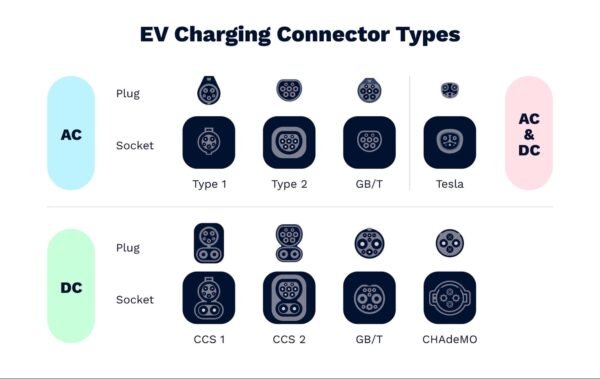
Understanding EV Connector Types
There are several connector types used in North America, and the one your vehicle has mostly depends on its model year and manufacturer.
Let’s take a closer look at each type.
- J1772: The standard connector for AC Level 1 and Level 2 charging on non-Tesla vehicles. It handles AC charging only, so it appears on home chargers and public Level 2 stations rather than fast chargers.
- CCS1: The Combined Charging System adds two DC pins beneath a J1772 connector, allowing the same port to handle both AC Level 2 and DC fast charging. It was the DC fast charging standard for non-Tesla vehicles in North America.
- NACS (SAE J3400): Originally developed by Tesla, the North American Charging Standard was standardized by SAE International as J3400. It handles AC Level 1, AC Level 2, and DC fast charging through a single, smaller connector, and it’s compatible with J1772 for AC charging through an adapter.
- CHAdeMO: An older DC fast charging standard found on a small number of earlier models. It’s being phased out in North America, though some public stations still support it.
Most automakers are switching to NACS. Many announced plans to adopt this standard in 2023, and most have committed to using it on vehicles starting in 2025. Government-funded public charging stations must support both CCS1 and NACS connectors, so drivers with either can use them.
When an automaker adopts NACS, not every car will have the new port immediately. NACS ports are added model by model, so even cars from the same brand and year might have different connectors. Always check your owner’s manual or look at your charge port instead of guessing.
When Do You Need an Adapter?
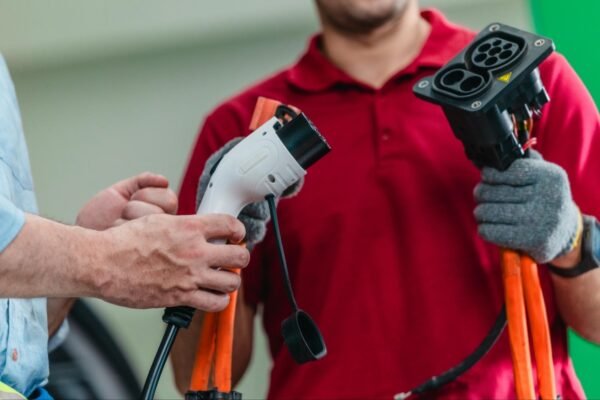
Adapters let cars with one connector type use chargers with another type. They are common at the moment, and most automakers moving to NACS offer approved adapters for their current vehicles.
AC and DC adapters are separate product categories and can’t be used interchangeably. An adapter rated for AC Level 2 charging (e.g., J1772-to-NACS adapter) won’t work for DC fast charging. DC fast charging uses much higher voltage and needs a special certified adapter.
Here are some tips to remember when using adapters:
- Use manufacturer-approved or network-approved adapters only. Unapproved adapters introduce safety risks and may cause charging sessions to fail.
- Match the adapter to the charging level, not just the plug shape.
- An adapter does not make charging faster.
- Just because a connector fits doesn’t mean you can charge right away. Your vehicle, the station, and the network all need to approve the session, so you might still need to set up an app or account.
Why Charging Speeds Differ Even With a Compatible Charger
Two people can use the same Level 2 charger and still get different charging speeds, even if both cars work properly. Charging speed depends on whichever is lower: the charger’s power or your car’s limit.
Every EV has an onboard charger that converts AC power from a Level 2 station into the DC power the battery stores. That onboard charger has a maximum rate. Level 2 charging can generally bring a battery-electric vehicle from empty to 80% in four to ten hours, but the vehicle sets the ceiling. If your vehicle’s onboard charger accepts 32 amps, installing a 48-amp home charger won’t charge it any faster.
DC fast charging works differently, since it bypasses the onboard charger and sends DC power directly to the battery. Speed still varies, though, because of:
- State of charge: Charging slows considerably as the battery fills, which is why fast charging sessions often stop around 80%.
- Battery temperature: A cold battery accepts power more slowly until it warms up.
- Vehicle type/setup: Different platforms support different peak charging rates.
- Station output: Not every fast charger delivers the same maximum power.
When charging at home, choose a charger with the right amperage for your car. Getting a higher-amp charger than your car can use only adds installation costs without making charging any faster.
How to Choose a Compatible Home Charger
Choosing a compatible home charger is mostly about your vehicle, not your house. Here are the steps to help you decide.
- Step 1 – Identify your vehicle’s connector: Check your charge port or your owner’s manual. Most non-Tesla cars from 2024 or earlier use J1772 for AC charging, while newer ones often have a NACS port. J1772 home chargers can work with NACS cars using an AC-rated adapter, and vice versa.
- Step 2 – Find your vehicle’s maximum AC charging rate: Your owner’s manual lists your car’s maximum charging rate in kilowatts or amps. This is the fastest your car can charge at home. If your car only takes 32 amps, getting a 48-amp charger just adds installation costs without speeding up charging. Match the charger to your car, not just the biggest number.
- Step 3 – Think about your next vehicle: Home chargers usually last longer than the car you use them with. If you plan to get a new EV while keeping the same charger, choose one that supports adapters or is a native NACS unit. This way, you’ll be ready as the industry moves to J3400.
- Step 4 – Decide which features you’ll actually use: * Features like scheduling, app connectivity, and usage tracking are helpful if you want to charge at certain times. These do not affect compatibility, so think of them as nice extras rather than essentials.
The charger you choose still has to work with your home’s wiring. Our overview of home electrical outlets explains what’s behind your walls, and our installation guide covers panel capacity, permits, plug-in versus hardwired options, and what the work costs.
What Compatibility Means for Your Charging Costs
Charging faster doesn’t mean your car uses more electricity. Filling the battery takes the same amount of energy, whether it takes four hours or fourteen. The only difference is how quickly you get that energy.
Where you charge is what changes the cost, and your connector type affects which stations you can use.
Home charging compared with public charging
The cost of home charging depends on your electricity plan. For example, with a fixed-rate plan you pay the same amount per kilowatt-hour whenever you charge. Plans with usage tiers or bill credits are also worth considering, since charging adds a few hundred kilowatt-hours a month and can move you past a threshold.
Public DC fast charging works differently. The network operator sets the price, and it typically runs higher per kilowatt-hour than charging at home, because you’re paying for the speed and the equipment behind it.
Your connector determines which public stations you can pull into without an adapter. Vehicles with a native NACS port, or an approved adapter, reach more of the network, which mostly means fewer situations where a fast charger is your only realistic option.
Drivers who charge at home most nights and use public fast charging mainly for road trips usually pay less per mile than those who rely on public stations every day.
Matching amperage to your vehicle
Buying a charger with more amps than your car can use increases hardware and installation costs, since higher-amp circuits need heavier wire and a bigger breaker. Your car’s onboard limit is the cap, so paying for extra capacity adds cost but not speed.
Where your electricity rate comes in
Most EV owners do most of their charging at home, so your electricity rate is the main factor in what charging costs you. The Texas average residential rate is 16.44 cents per kWh, though what you pay depends on your plan.
Your Electricity Facts Label shows your energy charge and how your plan changes at different usage levels. Remember, TDU delivery charges also go up with usage and are the same for everyone in your area, no matter the provider. Our companion guide to installing an EV charger at home explains how home charging affects a typical Texas bill.
Compare Texas electricity plans
Same Day Spark
Sign up before 12:00 pm CT, and we’ll have your power up and running the same day.
FAQs: EV Charger Compatibility
Check your charge port or your owner’s manual. Non-Tesla vehicles from model year 2024 and earlier typically use J1772 for AC charging and CCS1 for DC fast charging, while newer models are increasingly shipping with native NACS ports.
Many can, either through a native NACS port or an automaker-approved adapter. Access also depends on the station generation and network authorization, so check your vehicle manufacturer’s app before relying on a specific location.
Most Level 2 chargers use the J1772 connector, which works with most EVs sold in North America, sometimes with an adapter. Compatibility also depends on whether your vehicle’s onboard charger can accept the charger’s output.
Your vehicle’s onboard charger sets a maximum AC charging rate, and if that rate is lower than the charger’s output, the vehicle determines the speed. Battery state of charge and temperature also affect DC fast charging speeds.
If your current EV has a native NACS port, a NACS charger removes the need for an adapter. If you drive an older vehicle with J1772, a J1772 charger still works, and an adapter can bridge the gap when you upgrade.
Brought to you by justenergy.com
All images licensed from Adobe Stock.
The post EV Charger Compatibility appeared first on Just Energy.


